
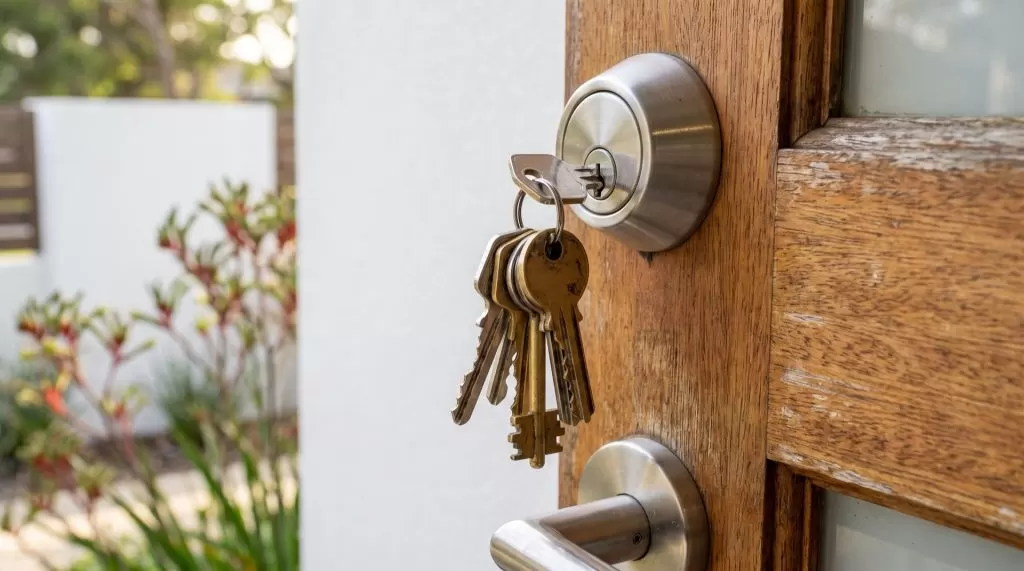
Rekey or replace? Usually rekey
If the lock still works properly, you almost never need a new one. You need new pins.
Rekeying changes the pins inside the lock you already own so a brand new key works and every old key stops. The lock, handle and door are untouched. Replace a lock only when it is worn or failing enough that a new one is cheaper than a return visit, or when you want something the old one cannot do — a deadbolt, a keypad, a different grade of hardware. If rekeying is the answer, here is how we rekey locks in Perth.
- Rekey when
- The lock works, but the keys are a problem
- Replace when
- The lock itself is worn or failing
- Typical house
- Six to eight locks, about an hour
What is actually inside the lock
What happens inside a lock when it is rekeyed?
Inside a cylinder is a row of small spring-loaded pins, each cut to a height that matches one particular key. Push in the right key and every pin lines up so the plug can turn. A rekey is simply swapping those pins for a set that matches a different key. Take the cylinder out, change the pins, refit it, test the door.
That is why the old keys stop working instantly, and why a rekey is cheaper than new hardware. You are not buying a lock, you are buying the fifteen minutes it takes to reset one.
When is rekeying enough?
Moving into a house, and you have no idea who holds a copy — previous owners, their relatives, tradespeople, a cleaner, the agent. A set of keys lost or stolen. A tenant moving out. A relationship ending. A housemate leaving. In all of those the locks are fine; it is the keys in circulation that are the problem.
When does a lock really need replacing?
When it is worn out and no longer works reliably: a key that needs lifting and jiggling, a deadlatch that will not catch, a handle gone loose on its spindle, visible corrosion on a coastal house. At that point a new lock is cheaper than us coming back to it. Also when you want something the old lock cannot do — a deadbolt where there was only a latch, or a keypad lock so nobody carries a key at all.
Can the whole house run on one key?
The other reason people rekey is to stop carrying four keys. We can bring the front, back, laundry, garage, gate and the security screens onto one key. The common snag in Perth is a house with Gainsborough doors and Lockwood screens: different profiles, so you end up with two keys unless the screen cylinders are changed. We will tell you which you have before we start.
What should landlords and property managers do?
Rekeying between tenants is much cheaper than replacing hardware every time, and it is the reason a rekey exists. We give the new tenant a fresh key, the old one stops working, and the hardware stays on the door for the next twenty years.
What customers say
Tap any review to read it on Google.
“I highly recommend Magnus from Amco Locksmiths. He was very quick to respond to my enquiry and was able to see me the next day. He showed up on time, had great communication and was very professional and friendly throughout the process.”
Read on Google →“I recently moved to a new house and wanted to change the locks for security. Magnus arrived on time and worked efficiently to do just that, also cutting more windows keys and rekeying the garage remote. He even oiled the squeaky garage door at no cost! I would use Amco again in a heartbeat.”
Read on Google →“Great communication advising when he would arrive. Quick, friendly service and very knowledgeable. Highly recommended.”
Read on Google →“Very friendly and replies fast! Definitely recommend!!”
Read on Google →“I needed an emergency locksmith today (Friday) and Magnus from Amco came to the rescue. Absolutely pleasant man very friendly and curteous. Explained everything including cost upfront. Completed the job professionally. Will definitely recommend Amco Locksmiths and Magnus anytime.”
Read on Google →Straight answers
What is the difference between rekeying and changing locks?
Rekeying changes the pins inside the lock you already have so a new key works and old keys stop. Changing locks means new hardware on the door. The lock stays the same in a rekey; only the key changes.
Is rekeying as secure as a new lock?
Yes, if the lock is in good condition. The security comes from the lock and the door, not from the age of the pins. If the lock is worn out we will say so.
When should I just replace the lock?
When it no longer works properly — a key that needs jiggling, a latch that will not catch, a loose handle, corrosion — or when you want something it cannot do, like a deadbolt or a keypad.
Can you put all my locks on one key?
Usually yes, including the security screens. Different key profiles between doors and screens can get in the way, and we will tell you before we start.
How long does a rekey take?
A typical Perth house of six to eight locks takes about an hour on site.
I am a landlord. Should I rekey between every tenant?
It is much cheaper than replacing hardware each time, and it means the previous tenant’s keys stop working. It is the main reason rekeying exists.