
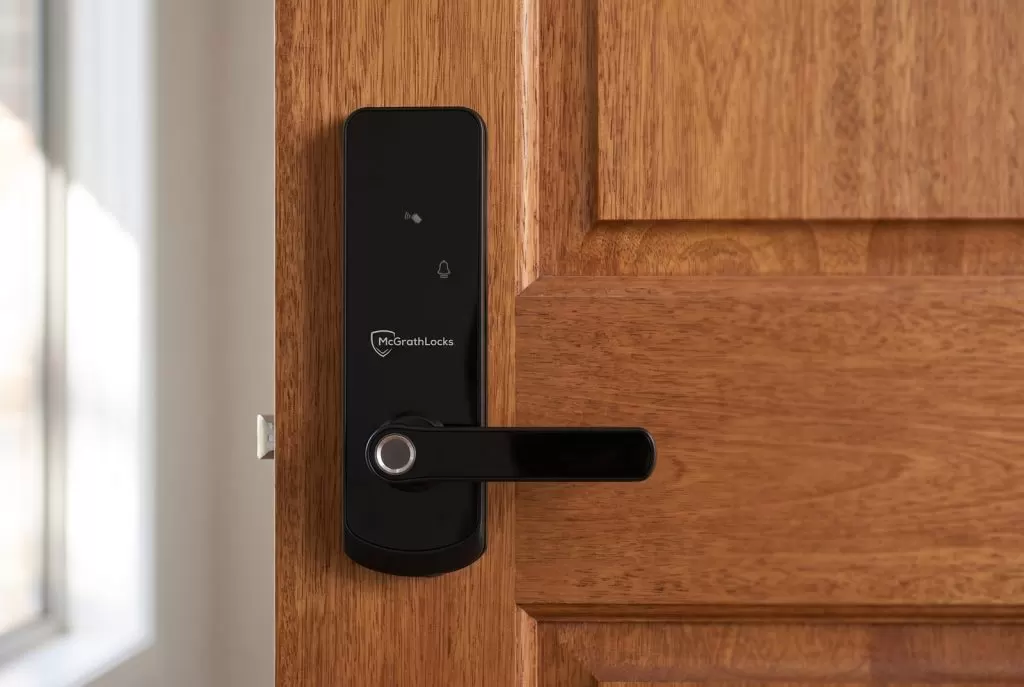
Is a digital lock worth it?
For some households it is genuinely better. For others a key is still the right answer, and we will say so.
The real gain is not gadgetry, it is that nobody has to carry, hide or chase a key. Codes can be given out and taken away without cutting anything. The trade is batteries and a bit of setup. We fit McGrath, Lion Head, Lockton, Carbine, Lockwood and Yale, and every lock we fit keeps a second way in.
- Biggest gain
- No keys to carry, hide, lose or chase
- The trade
- Batteries, and a little setup
- Always
- A second way in on every lock we fit
What you actually gain
Nobody carries a key
Children who lose things, a teenager who forgets, an older parent who struggles with a key in a stiff lock, a partner on shift work. A code each removes the whole problem. The spare key under the pot — which is the first place anybody looks — goes in the bin.
Access you can take away
A cleaner, a dog walker, a tradesperson or a relative can have a code that you delete afterwards. With keys, giving access means cutting a key and hoping it comes back. This is the single most useful feature for anybody who has people coming and going.
Rentals and short stays
If you let a property, a digital lock ends the key handover entirely. Each guest or tenant gets their own code, and it stops working when they leave.
What you give up
Batteries. Most locks warn you for weeks before they run out and changing them takes a minute, but it is a thing you now have to notice. There is also a little setup — codes, users, and for app control a WiFi connection and sometimes a gateway hub.
The question everybody asks
What happens if the battery dies? You still get in. Every lock we fit has a second way in: most take a key, and some let you hold a nine volt battery against the front to wake the lock up long enough to enter your code. We would not fit one that left you standing outside.
Will it fit your door?
Most solid timber front doors take a digital lock easily. Thin, hollow, glass-panel and aluminium-framed doors need particular models, and so do sliding doors. The quickest way to find out is to send us a photo of the door edge where the bolt comes out and the front of your current lock.
The brands we fit
McGrath, Lion Head, Lockton, Carbine, Lockwood and Yale, in that order of how often we fit them. We do not fit brands we cannot get parts and support for, because a smart lock nobody can service is worse than a key.
What customers say
Tap any review to read it on Google.
“I highly recommend Magnus from Amco Locksmiths. He was very quick to respond to my enquiry and was able to see me the next day. He showed up on time, had great communication and was very professional and friendly throughout the process.”
Read on Google →“I recently moved to a new house and wanted to change the locks for security. Magnus arrived on time and worked efficiently to do just that, also cutting more windows keys and rekeying the garage remote. He even oiled the squeaky garage door at no cost! I would use Amco again in a heartbeat.”
Read on Google →“Great communication advising when he would arrive. Quick, friendly service and very knowledgeable. Highly recommended.”
Read on Google →“Very friendly and replies fast! Definitely recommend!!”
Read on Google →“I needed an emergency locksmith today (Friday) and Magnus from Amco came to the rescue. Absolutely pleasant man very friendly and curteous. Explained everything including cost upfront. Completed the job professionally. Will definitely recommend Amco Locksmiths and Magnus anytime.”
Read on Google →Straight answers
What happens if the battery goes flat?
You still get in. Every lock we fit keeps a second way in — usually a key, and on some models a nine volt battery held against the front. Most warn you for weeks beforehand.
Can I give someone a code and then cancel it?
Yes, and it is the most useful thing about them. Cleaners, tradespeople, dog walkers and guests can each have a code you delete afterwards.
Do I need WiFi?
Only for app control from away from the house. Plenty of people run a keypad lock with no WiFi at all. Some models reach your WiFi directly and others need a small gateway hub — we will tell you which before you buy.
Will it fit my door?
Most solid timber doors take one easily. Thin, glass, aluminium and sliding doors need specific models. Send us a photo of the door edge and the front of your current lock.
Which brands do you fit?
McGrath, Lion Head, Lockton, Carbine, Lockwood and Yale. We only fit brands we can get parts and support for.
Is a digital lock as secure as a deadbolt?
A good digital lock throws a real bolt like any other lock. The security comes from the bolt, the door and the frame, not from whether you turn a key or type a code.